Articles are parts of the sentence that are placed before a noun to help us understand if we’re talking about something known or unknown.
In English, if I say “I saw A cat” or “I saw THE cat” I’m talking about a random cat I probably have never seen before in the first case and about a specific cat I am familiar with in the second case. In English we use A, indefinite article, or its phonetic variation AN, and THE, definite article.
In Italian, articles also allow us the gather information of gender and number about the noun they accompany since they match in gender and number the noun they refer to. Despite being useful in identifying gender and number of nouns, this also means that we have many more articles than English. Not only do they match in gender and number, but they also change based on the sound the noun begins with. This is to help with pronunciation.
You will need to figure out if the word following the article starts with a vowel sound (not necessarily a letter, for example HA is considered a vowel sound despite starting with a consonant), a special consonant sound (S followed by consonant, x, z, y and gn) or a simple consonant sound (all the other ones)
Definite articles
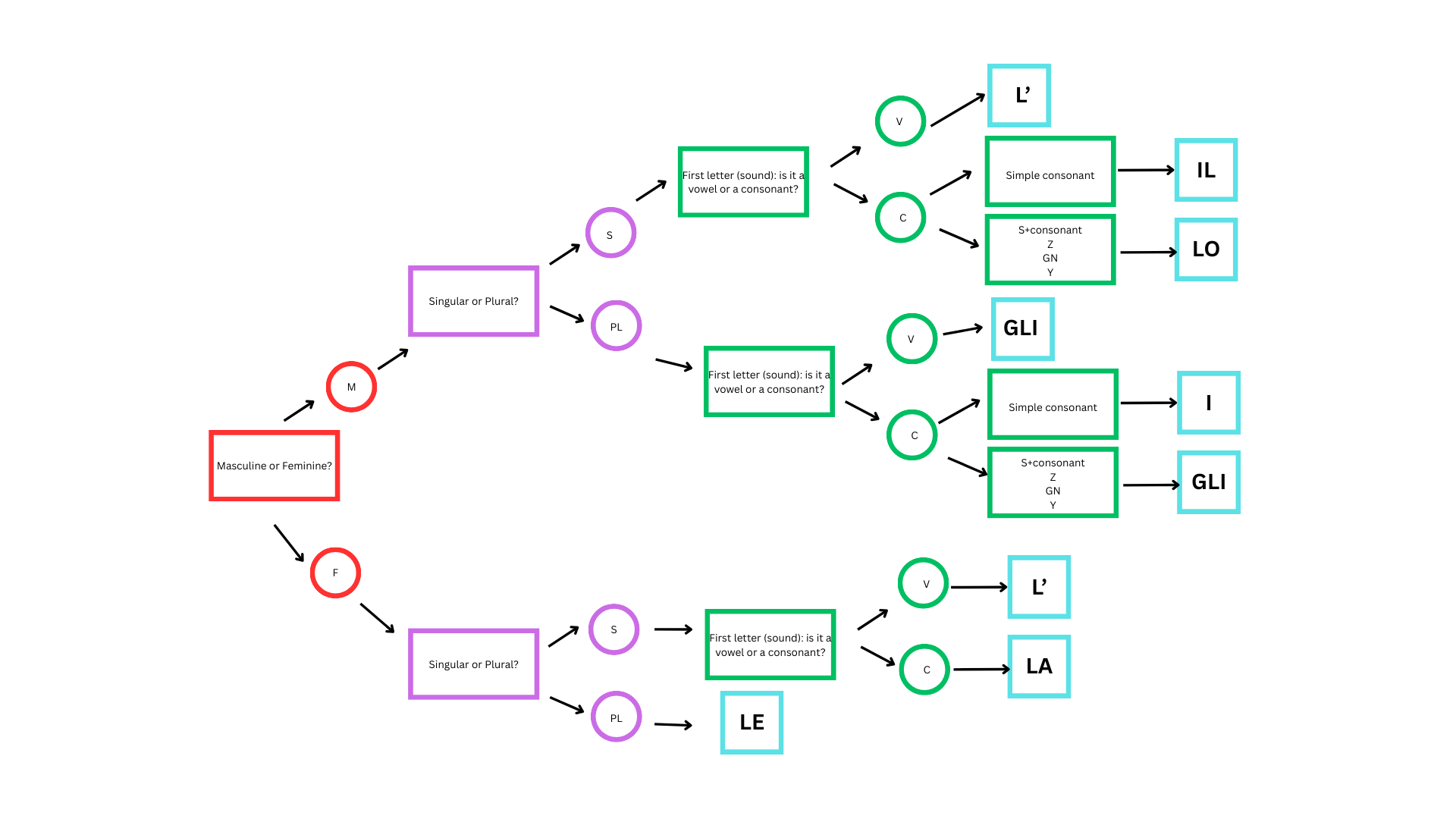
Follow the attached chart to learn how to decide which definite article to use: First we enquire about gender, then about number, and finally about the sound that immediately follows the article.
For example, if I have the noun ZIO, I choose Masculine, Singular, Starts with consonant, Special consonant (Z) and the result is LO > lo zio
If I have the noun AMICA, I choose Feminine, Singular, Starts with vowel and the result is L’ > l’amica
But be careful! If I have __ MIA AMICA (my friend), the sound following the article changes, so the result is LA > la mia amica
Test your understanding with the attached worksheet!
Indefinite articles
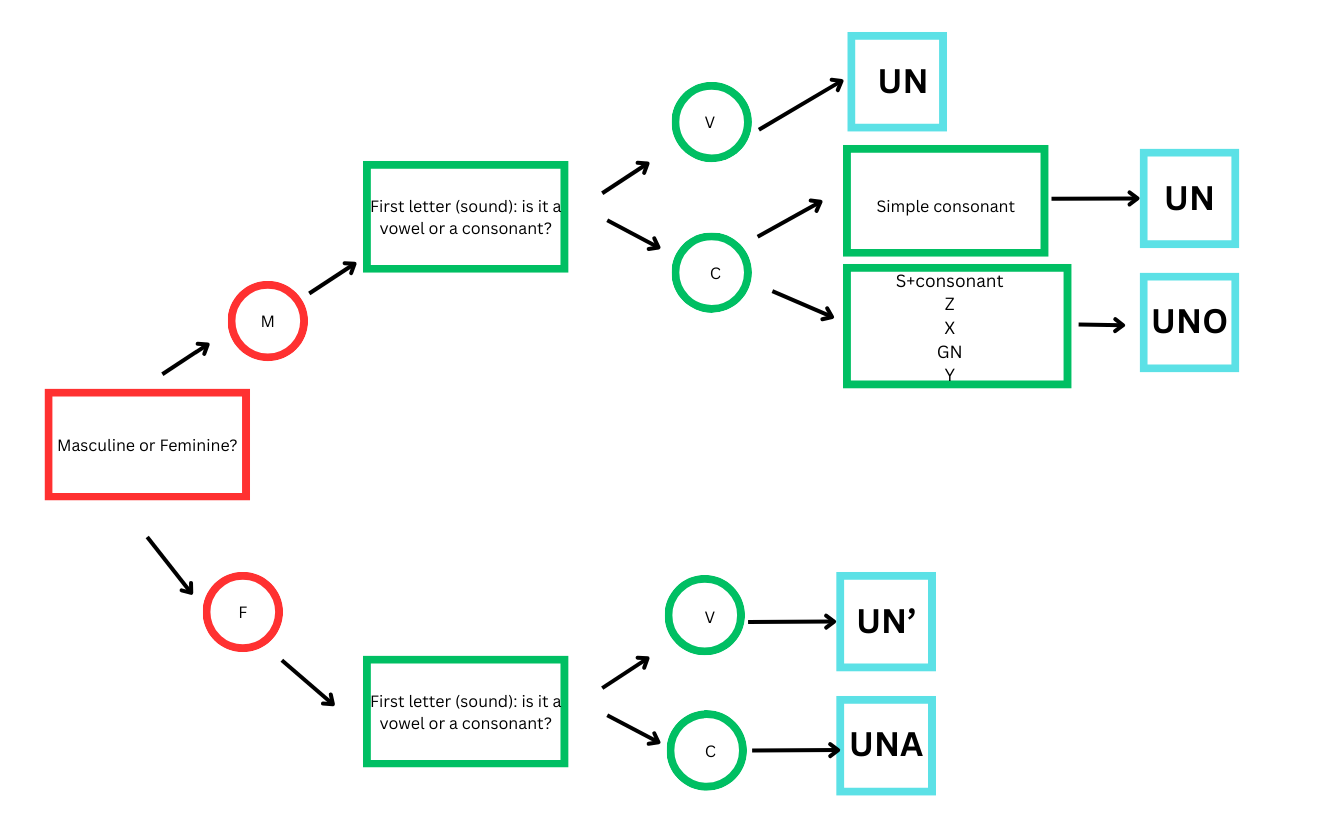
Follow the attached chart to learn how to decide which indefinite article to use: in this case, we don’t need to worry about number because ‘A’ really means one! First we enquire about gender, and then about the sound that immediately follows the article.
For example, if I have the noun GNOCCO, I choose Masculine, Starts with consonant, Special consonant sound (GN) and the result is UNO > uno gnocco
If I have the noun CASA, I choose Feminine, Starts with Consonant and the result is UNA > una casa
Be mindful of the difference between un (M) and un’ (F) followed by vowel. If I have the noun AMICA, I choose Feminine, Starts with vowel and the result is UN’ > un’amica, but AMICO [Masculine, Starts with vowel] is un amico.
Test your understanding with the attached worksheet!
 Talk&Learn - Foreign Language and Tutoring Services